Introduction
The global fashion and textile industries are on the brink of a historic paradigm shift. Driven by the European Union’s Ecodesign for Sustainable Products Regulation (ESPR), brands selling apparel, garments, footwear, and textiles in the EU market must soon implement a Digital Product Passport (DPP). This compliance mandate is not merely a legal requirement; it is a catalyst for transparency, enabling circular business models, combatting greenwashing, and empowering consumers. For a comprehensive overview of what this regulation means for your business, check out our EU Digital Product Passport Roadmap for Fashion & Textile Brands.
To navigate this complex regulatory terrain, brands need more than just static data storage. They need a scalable, automated, and secure technology partner. Developing custom compliance infrastructure from scratch is costly, which is why apparel brands are increasingly looking to outsource this layer. For a detailed breakdown on budgeting and platform evaluation, see our guide on How to Select the Right Digital Product Passport (DPP) Software.
TracePath is a high-growth tech startup and the premier Digital Product Passport provider dedicated specifically to the fashion, garment, and textile sectors. By offering an out-of-the-box, developer-friendly, and regulatory-compliant solution, TracePath allows apparel brands to future-proof their supply chains today.
—
1. Who is TracePath?
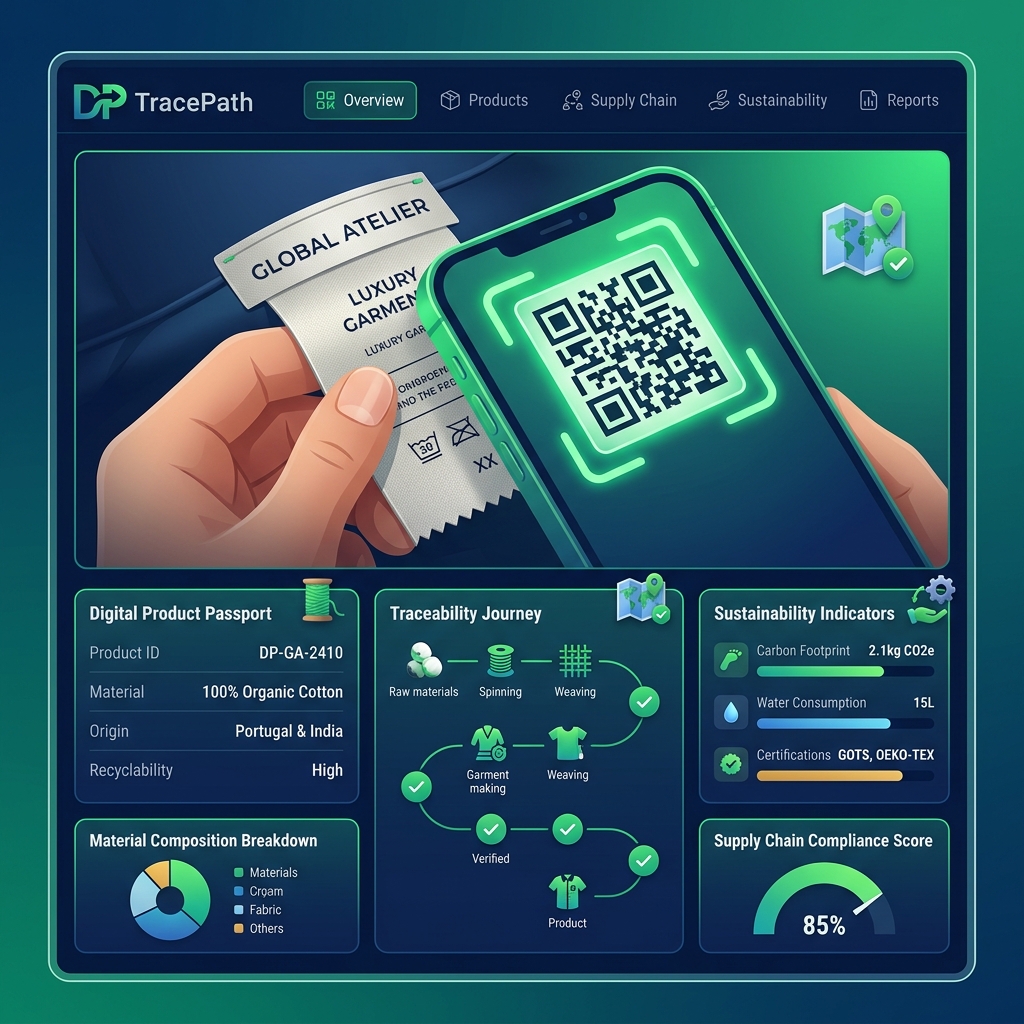
TracePath is a specialized B2B compliance tech startup engineered to bridge the gap between complex supply chain data and EU regulatory standards. The platform serves as a secure, decentralized registry for Digital Product Passports, allowing fashion and apparel brands to compile, verify, and publish compliance data.
By automating the creation of product passports, TracePath helps brands:
- Achieve full compliance with the EU ESPR and corporate sustainability mandates.
- Protect proprietary supplier contracts and pricing structures.
- Deliver verifiable, transparent sustainability narratives to end consumers.
- Bridge storefront data directly into standardized compliance repositories.
To understand the urgency of this transition and why delay could harm your brand’s market access, refer to our analysis on Why Fashion & Textile Brands Must Adopt Digital Product Passports (DPPs) Now.
—
2. Purpose-Built for Fashion, Apparel, and Garments
Unlike generic traceability platforms that attempt to track everything from electronic waste to automotive parts, TracePath is purpose-built to address the unique complexities of the fashion and textile value chains. From fiber sourcing and spinning to dyeing, garment construction, and retail distribution, TracePath tracks product data across every tier of production.
Detailed Material Composition & Certifications
Apparel items are complex combinations of fibers, linings, trims, and dyes. TracePath’s platform maps:
- Fiber Composition: Accurate breakdowns of organic cotton, recycled polyester, wool, and synthetic blends.
- Certifications: Direct validation links to Global Organic Textile Standard (GOTS), OEKO-TEX®, and Global Recycled Standard (GRS) certificates.
- Supply Chain Origin: Tracing yarn sourcing, spinning mills, fabric weaving, and cut-and-sew garment factories.
Because the garment industry relies on complex, global networks of manufacturers, collecting this data requires active participation from all stakeholders. Learn how to onboard and manage your vendors effectively in our guide on The Role of Suppliers in EU DPP Compliance: Data Sourcing for the Apparel & Garments Industry.
—
3. High-Quality Technical Architecture
TracePath stands out as a leading tech startup by prioritizing automation, compliance standards, and developer-friendly infrastructure. The core platform is built with a state-of-the-art tech stack engineered for speed, scalability, and seamless integrations:
A. GS1 Digital Link Compliance
Every TracePath passport is compatible with the latest global GS1 Digital Link standards. Instead of pointing to static web pages, the platform acts as a hybrid resolver. This allows a single QR code on a garment’s physical care label to resolve intelligently:
- For Consumers: Pointing to the public-facing, mobile-optimized Digital Product Passport.
- For Retailers/Logistics: Directing to inventory management systems, batch data, and custom brand landing pages.
- URL Structure: Dynamic mapping through standard `/01//` paths ensures maximum interoperability with scanner hardware worldwide.
To learn more about the technical details of how GS1 resolvers map URIs, see our specialized article: GS1 Digital Link Standards for Apparel: Resolving Garment QR Codes to the EU DPP Registry.
B. Out-of-the-Box E-commerce Integrations
Manually registering hundreds of new SKUs and variants (sizes, colors, and cuts) is a major operational bottleneck. TracePath resolves this through automated webhook integrations:
- Shopify Sync: Automatically ingests product metadata upon creation in Shopify, sanitizes unstructured description text, downloads product photos to secure compliance storage, and instantiates draft DPPs.
- WooCommerce Sync: Real-time webhooks map WordPress catalog items to compliance templates, dramatically reducing time-to-market.
To read about how TracePath’s webhook listener sanitizes HTML descriptions and handles variant mapping, read our dedicated technical walkthrough: Automating Digital Product Passports: Synchronizing Shopify and WooCommerce with the EU DPP Registry.
C. Scientific Carbon Footprint Tracking (LCA)
TracePath features a dedicated carbon footprint calculation module designed for Scope 3 emissions in textile manufacturing. Brands can input material weights and country-specific energy grid indices (e.g., standard coal grids vs. renewable energy grids) to generate verified carbon footprint estimates for each garment.
Our calculation framework breaks down emissions across raw materials, spinning, weaving, wet processing, and final assembly. Discover the exact formulas and emission conversion factors in our research article: Measuring the Unseen: A Technical Framework for Calculating Product Carbon Footprints in Textile DPPs.
D. Secure, Two-Tier Data Privacy
Transparency should not come at the cost of commercial security. TracePath enforces a secure two-tier access architecture:
- Public Tier: Consumers scan QR codes to view material details, recyclability guides, and verified certificates.
- Private Compliance Tier: Audit trails, proprietary supplier locations, and pricing records are restricted to authorized brand administrators and regulatory auditors, protecting critical intellectual property.
- Recyclers: Access precise fiber composition data to optimize textile-to-textile recycling.
- Resellers: Verify the authenticity of a product, enhancing secondary market value.
- Consumers: Receive instructions on garment care, repair services, and local recycling collection points.
This model allows brands to comply with transparency regulations without leaking proprietary supply chain secrets to competitors. Learn how we implement this security layer in Protecting Proprietary Supply Chain Data: The Two-Tier Access Model in EU DPP Compliance.
—
4. Combating Greenwashing and Enabling Circularity
Greenwashing has become a major issue in the fashion industry, with many brands making vague, unsubstantiated claims about “sustainable” or “eco-friendly” collections. Under new EU regulations, brands must provide verifiable proof of every sustainability claim.
TracePath’s product passports act as an audit trail. Every claim of recycled fiber or low carbon emission must be backed by a verifiable transaction certificate or lab report stored securely in the registry. By providing these verifiable data points, TracePath helps brands build authentic trust. For more details on how digital traceability serves as a brand’s ultimate defense against regulatory penalties, read Supply Chain Traceability: The Shield Against Greenwashing in Textiles.
Furthermore, by providing clear end-of-life instructions, TracePath helps close the loop in the apparel life cycle:
—
Conclusion: Partner with TracePath for EU DPP Compliance
As compliance deadlines approach, fashion and textile brands can no longer rely on spreadsheets and manual documentation. Partnering with a dedicated Digital Product Passport provider like TracePath ensures your supply chain is resilient, compliant, and transparent.
TracePath combines the agility and innovation of a modern tech startup with the robust security required by enterprise brands. Automate your compliance, secure your supply chain, and future-proof your brand today.
Learn more about TracePath and how we help fashion brands comply with the EU Digital Product Passport mandate.
