In 2021, the European Commission analysed 344 sustainability claims made by fashion and consumer goods brands across the EU. The findings were damning: 53% of the claims were found to be vague, misleading, or unsubstantiated. Another 40% had no supporting evidence whatsoever. This systemic misrepresentation — what regulators and the media call greenwashing — has triggered one of the most consequential legislative responses in the history of EU consumer protection: the Green Claims Directive.
For textile brands, the era of aspirational sustainability language — “eco-conscious,” “planet-friendly,” “made with purpose” — is coming to an abrupt end. What replaces it is an era of verifiable, traceable, auditable supply chain data. This article explores why traceability is the only credible defence against greenwashing accusations, how supply chains produce and lose transparency at each tier, and what technical and operational steps brands must take to build a defensible record.
The Anatomy of Greenwashing in Textiles
Greenwashing in fashion is rarely a deliberate act of fraud. More often, it emerges from the structural complexity of global supply chains, where brands genuinely lose visibility beyond their Tier 1 manufacturers. The problem manifests in several distinct forms:
1. Claim Without Proof
The most common form — a brand states “made with sustainable cotton” on its website or product label, but has no documentation trail connecting the raw cotton purchased to the finished garment on the shelf. Without chain-of-custody documentation, the claim cannot be verified — and under the Green Claims Directive, unverified claims are legally equivalent to false claims.
2. Certificate Without Chain of Custody
A brand holds a GOTS (Global Organic Textile Standard) transaction certificate for a yarn purchase. However, between the yarn stage and the finished garment, the material passed through unverified dyeing and finishing facilities. The GOTS certificate covers the yarn — not the final product. Representing the garment as “GOTS-certified” misrepresents the scope of the certification. This is scope greenwashing — among the most legally dangerous for brands.
To avoid scope greenwashing while keeping supplier agreements confidential, brands must implement robust data security measures. See our analysis of the two-tier data access model for DPP compliance.
3. Selective Scope Reporting (Cherry-Picking)
A brand publishes carbon emission data for its direct operations (Scope 1 and 2) but omits Scope 3 emissions, which — in the fashion industry — typically represent 70–90% of total emissions. Highlighting only the lowest emission numbers while remaining silent about the supply chain footprint creates a fundamentally misleading picture. Under the new Green Claims rules, carbon footprint claims must reflect the entire product lifecycle.
Why Traceability is the Only Defence
Under the Green Claims Directive, any sustainability claim must be backed by a **life cycle assessment (LCA)** or a verified **chain of custody**. Third-party certification is no longer optional; it must be mapped to the specific product unit placed on the market. This is where supply chain traceability acts as a shield:
- Verifiable Provenance: By tracing materials from farm to hanger, brands can produce a verified paper trail showing exactly where, when, and by whom each component was made.
- Real-Time Verification: If a regulator questions a claim, the brand can resolve the query instantly by pointing to the product’s Digital Product Passport (DPP), which links to active, verified transaction certificates.
- Defensibility: In the event of a greenwashing lawsuit, a traceable supply chain provides a legally defensible audit trail, shifting the burden of proof back to the verification systems.
The Impact of the EU Green Claims Directive
The Green Claims Directive (published in draft by the European Commission) sets strict requirements on environmental marketing. Brands must adhere to the following core rules:
| Prohibited Marketing Action | Mandatory Compliance Solution |
|---|---|
| Using generic labels like “Green,” “Eco,” or “Conscious.” | Providing exact, quantified environmental indicators (e.g., “70% lower carbon footprint than industry average, backed by LCA study #12093”). |
| Displaying self-created sustainability logos or badges. | Using only officially recognized third-party certification schemes (GOTS, OEKO-TEX, EU Ecolabel) that are independently audited. |
| Making climate compensation or carbon offset claims. | Differentiating between internal emission reductions and external offsets. Offsets cannot be used to label a product “carbon neutral.” |
How Supply Chains Lose Transparency
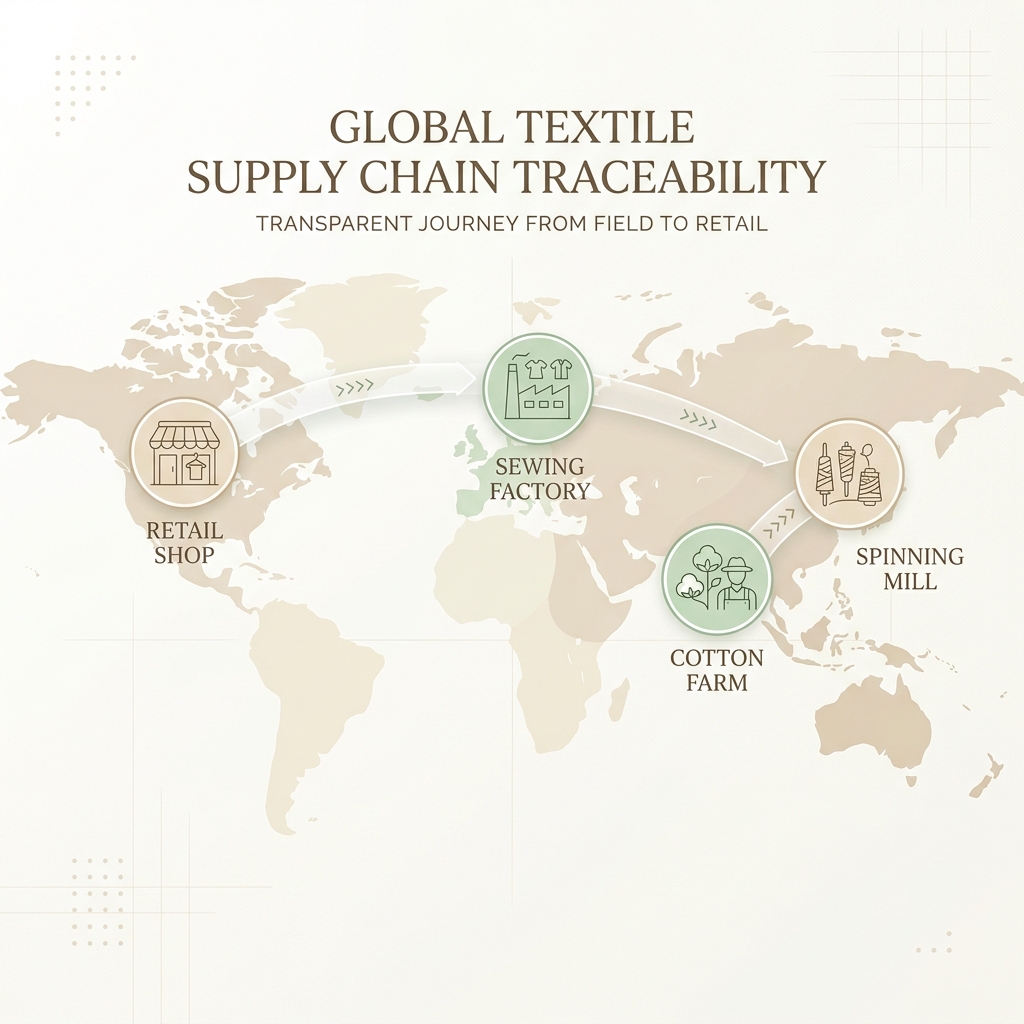
To implement effective traceability, sourcing teams must understand where data is lost in the textile supply chain. The process is divided into four distinct tiers:
Tier 1: Assembly (Garment Factories)
The final stage where fabric is cut, sewn, and finished. While most brands know their Tier 1 suppliers, they often fail to collect facility-level data (such as energy mix, wage audits, and chemical management systems) required for DPP compliance.
Tier 2: Wet Processing & Fabric Production (Dyehouses & Weavers)
This is where the raw material is transformed into finished fabric. It is the most chemically intensive and water-intensive phase of manufacturing. It is also where traceability frequently breaks down, as fabric is often bought from merchants rather than directly from the mills.
Tier 3: Yarn Processing (Spinners)
Spinning mills blend fibres from multiple sources to create yarn. Once blended, physical tracing becomes virtually impossible. Brands must rely on transactional tracing (Transaction Certificates) to prove organic or recycled content before the blending occurs.
Tier 4: Raw Material (Farms & Recyclers)
The origin of the fibre—cotton fields, sheep farms, or polyester recycling plants. Tracing to Tier 4 requires connecting with global agricultural networks and recycling hubs, representing the highest logistical hurdle in fashion compliance.
Building a Traceable Supply Chain: An Action Plan
Transitioning from static sustainability claims to verified traceability involves three main stages:
- Map Your Supply Chain: Start by mapping your Tier 1 and Tier 2 partners. Work upstream to spinners and raw material sources. Build a directory of all facilities involved in your manufacturing. Ensure you utilize the GS1 Digital Link standards for physical labeling of these tiers.
- Implement a Digital Chain of Custody: Move away from manual document chasing. Use a B2B compliance workspace like TracePath to securely collect, store, and link GOTS, GRS, and OEKO-TEX certificates directly to your product catalog. TracePath’s built-in validation layer checks document authenticity in real-time, preventing Green Claims violations.
- Publish Your Proof via DPP: Web-enable your traceability data. Generate unique, scannable QR codes for your garments that link directly to active, verified product passports. This provides immediate, credible proof to consumers and regulators alike, turning transparency into a competitive brand asset.
Conclusion: The Regulatory Era Has Arrived
The era of marketing-driven sustainability is over. As the EU Green Claims Directive and ESPR regulations enter into force, fashion and textile brands must backing their environmental claims with verifiable supply chain data. Implementing robust, end-to-end traceability is no longer just a brand differentiator—it is a critical requirement for regulatory compliance and market access.
Learn more about TracePath and how we help fashion brands comply with the EU Digital Product Passport mandate.
